Monday, April 26, 2021

Haji Malang Baba Palki- A Procession at Urs Festival

In true syncretic tradition, Haji Malang Dargah situated at Shree Malanggad in Kalyan is one of the rare pilgrimages that attracts both Hindus and Muslims. It is a holy 300-year-old shrine of Hazrat Abdur Rahman Haji Malang Baba, a Sufi saint from the Middle East. The religious rituals at the dargah are performed by both Muslim Mutavalli (claiming to be a distant family member of the Saint) and a Hindu Vahivatdar (a traditional priest belonging to the Hindu Karandekar family). The elaborate history of the Haji Malang Baba, as well as the Malanggad fort, attracts thousands of devotees of Baba from various parts of the country.

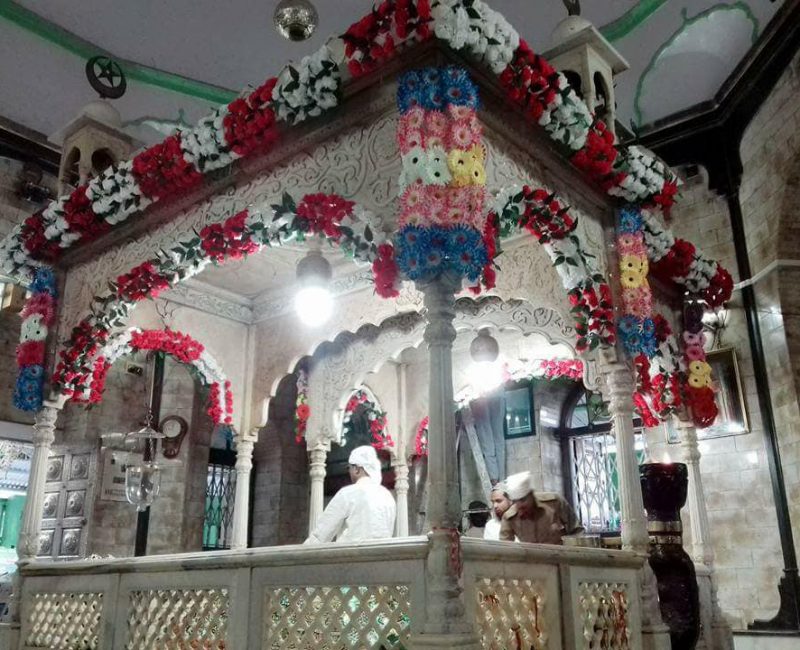
Haji Malang Dargah decorated during Urs Festival

Urs Festival at Haji Malang Dargah

Every year in February, a festival is organized on the picturesque Malanggad mountain where Haji Malang Baba's holy shrine is located. On the occasion of Baba Haji Malang's annual death ceremony, people celebrate the "Urs Festival". People of various castes and creeds participate in the Urs ceremony with zeal. Since the hill is crowded with thousands of devotees during this period, the police force is present to handle the crowd and avoid any misconduct.

Urs Festival Celebration

Haji Malang Baba’s Palki Procession 

The festivities start with the unfurling of the ceremonial flag and lasts for nine days. On the first day of the annual celebration, the palanquin of Baba Haji Malang known as "Palki" is used in the juloos (procession). This program is popularly called "Sandal Palki ka Gasht". 

Palki of Hazrat Haji Malang Shah Baba

It starts from Haji Malang Dargah at midnight, covers the entire Haji Malang mountain, and reaches back the dargah around 5 am at the dawn. The procession is led by Hindu Vahivatdar Madhav Gopal Ketkar.

Palki Procession at the Haji Malang Urs Festival

Sacred tomb of Haji Malang Baba decorated during Urs


Other Attractions of the Urs Festival

Followed by Haji Malang Baba Palki, other programs like “Milad Sharif”, “Dhamal”, “Mir Sultan Shah Baba Urs”, and “Gusal Sharif” take place on the subsequent days. 

During the procession, the entire mountain is illuminated by beautiful lights. There is a spectacular series of fireworks displayed on the mountain. The Palki of Haji Malang Baba is decorated with flowers. The devotees pay their respect with floral chadars, cloth chadars, sandalwood, and other perfumed offerings.

Dargah premises lit up with light and floral decorations

Nobody sleeps till dawn as they enjoy the spiritual atmosphere and captivating firework display at the mountain. Muslim communities perform Qawwalis, devotional songs whereas Hindu communities perform Aarti in the procession.

Pilgrims gathered near the dargah during Urs Festival midnight

Accommodations are available near Haji Malang Dargah for the pilgrims. If you are planning to travel to Haji Malang Gad, the duration of Urs Festival is the best time to visit the dargah and witness the spiritual splendor.


Friday, April 23, 2021

Display of Communal Harmony at Haji Malang Urus

"Haji Malang Dargah" is known to be a 300-year-old dargah in Maharashtra, located on a fort called Malanggad. The Malanggad fort is situated near Kalyan Railway Station which is above 789m of sea level and popular for the trek towards the top of the mountain. The Haji Malang Dargah is located on the first level of the mountain. Malanggad Fort has been divided into 3 levels that is "Pir Machi", "Sone Machi" and "Balekilla".


Haji Malang Dargah is the holy shrine of Haji Abdur Rehman Malang Baba. The holy shrine was built by the devotees on the Malanggad fort. From the time it was built till today the Dargah is managed by the people from Hindu and Muslim community. This is one of the few shrines where a Muslim Mutavalli(a family member of the saint) and Hindu Vahivatdar(a priest from the family of Hindu Vahivatdar) have found working together to run the religious rituals in harmony. 

During the "war in 1780 between the British East India Company and the Marathas" for the Malanggad fort, the Hindu Pandurang Katekar along with his family and neighbours fought bravely against British Army to push them back from conquering the Fort. While the war was raging there were two Gardi musketeers Abu Sheikh Jamadar and Aziz Khan Jamadar from the Muslim community who responded to the British attacks. The Hindu and Muslim communities on the Malanggad fort have been seen living in harmony from the old days.

Later with the help of Nana Phadnavis, the Marathas pushed back the British Army, in 1780 British army decided and left the fort to the Marathas.


Haji Malang Dargah’s Urus Festival

Several hundreds of faithful were part of the religious festivities at Haji Malang Dargah, as the 1-month Urus festival got off to a fervent and colourful start every February. This festival is celebrated on the occasion of Haji Malang Baba’s annual death ceremony. The rituals, which begins with the Baba’s Palki (Procession) where the followers of Haji Malang Baba carry the wagon and forms the Juloos. Baba’s Palki is beautifully decorated with chadars and flowers. The followers of Haji Malang Baba consist of people from multiple religion like Hindu and Muslim communities, they come together and covers the route of the entire fort. The route of the Palki begins at the midnight covers the Malanggad fort in the nighttime and returns till the morning.


During the "Urus festival" entire Malanggad fort is decorated with beautiful lights. The kids on the mountain burns firecrackers during the ceremony which lightens up the mountain in the nighttime. The display of the Firecrackers is delightful to watch. The locals and the followers of the Baba visiting the Dargah for the festival stays awake to enjoy the view of the Dargah which is decorated for the festival, to enjoy the view of the firecrackers burnt by the kids in the night and to participate in the religious harmony atmosphere. In the nighttime, Qawwalis are being sung by the people from the Muslim community whereas as Hindu community people gather around and perform aarti during the Palki.


Haji Malang Dargah is one among the few dargahs in the country where several people from different communities come together to pray the "Haji Malang Baba" and to celebrate the Urus festival. It is considered to be the symbol of communal harmony as the people from multiple belief visits the dargah and pay their respect.

Thursday, April 22, 2021

Tale of Haji Malang Baba's 'Duldul' Horse

Haji Malang Baba is a Sufi Saint who traveled from the Middle East in the 12th century AD. During the Maurya dynasty, when King Naladev ruled, Malang Baba reached Bramhanwadi with his followers. It is believed that God himself had sent Malang Baba to the fort to salvage the fear-stricken people, ensure prosperity in the society by eradicating the evil and devastation caused by the demons in King Naladev’s state.


The place where Haji Malang Baba's Horse "Duldul" was buried

Haji Malang Baba’s Horse “Duldul”

It is believed that Haji Malang Baba had a horse ‘Duldul’ who was his companion at the fort. It was described that in those older and wilder times, Allah found it unacceptable that demons harassed people and innocent animals on this mountain by devouring them. At the time, it is said, the hill was so huge that fires lit at its top could be seen to Mecca-Medina. When Allah identified the fire, he asked Haji Malang Baba about the same. Baba noticed that the fire that has originated is from a fort in a country named Hindustan and Allah, being angry, asked Malang Baba to visit the Haji Malang Gad immediately and kill the demons. Due to this, Haji Malang Baba starting their journey for Konkan on his horse and with two companions to defeat the demons. 

On reaching the village Brahmanwadi, which is the base of the hill, Baba felt tired, thirsty, and exhausted at which a resident Brahmin family gave him a glass of milk and a place to rest. Baba felt very satisfied with the family of Brahmanwadi, who were the Ketkars of the village.

Then Malang Baba and his companions went up to the first stage, where one of Baba’s companions, decided to rest, to which Haji Malang Baba agreed. Now Baba was in a doubt about how to move ahead, so he requested his horse Duldul to reach the top of the hill. Malang Baba, thought of jumping from the hill, as to no one on this earth is born to live forever, he has to die one day or another. He has to just perform good deeds in his life. Duldul agreed to this thought of Haji Malang Baba and wagging his tail with all his strength, he flew like a bird to some distance at the top of the hill before he died. Haji Malang Baba’s companions then buried Duldul at the spot where he died and his horseshoe emerged magically over there. One can still visit and have a sight of the magical horseshoe.

He generated water on top of the hill for his ablutions by flinging and banging something he held in his hand to the ground with the name of Allah on his lips. Miraculously, water gushed out of the spot that devotees call “Chasma” or fountain1.


Ghode ki Taap

Magic and Myth about Haji Malang Baba’s Horse “Duldul”

It is believed that when Haji Malang Baba reached the base with his horse “Duldul”, its height was huge, as the horse had set his footprints on the fort. It was said that when the Baba’s horse ‘Duldul’ touched the hill, the water started flowing from that exact place. The place is known to be “Ghode ki Taap”. Surprisingly the water is fresh and clear, and even today it continues to flow.

Want to visit the Haji Malang Dargah? Check out our blog Haji Malang Dargah, A Holy Shrine of Haji Malang Baba.